


Page 73 - KLIFF2022eBook
P. 73
KLIFF 2022 PROGRAMME BOOK
Faster bank asset growth: With the more supportive economic outlook for many Islamic finance countries, bank financing
growth is expected to accelerate. In Saudi Arabia, continued mortgage demand and the implementation of Vision 2030 projects
will create opportunities for industry expansion. In other GCC countries, more positive economic sentiment, government
spending, and investments will help accelerate growth. In Southeast Asia, we expect the $290 billion Islamic banking market to
expand at a compound annual growth rate of about 8% over the next three years. Meanwhile, in Turkey we still expect nominal
lending activity to remain elevated, with growth estimated at 42% in 2022, but the global contribution will likely be affected by
lira volatility.
Declining sukuk volume but increasing stock: S&P Global Ratings forecasts total sukuk issuance will decline in 2022.
This compares with a stabilization at $147.4 billion in 2021, versus $148.4 billion in 2020, and the 10% increase in foreign-
currency-denominated issuance over the same period. Several factors are at play. Shrinking global liquidity and increasing
complexity related to regulatory standards are likely to hold back sukuk issuance in 2022, assuming any adverse COVID-19-
related disruption in core Islamic finance countries remains in check. We also expect lower financing needs for some core
Islamic finance countries and some corporates to remain prudent with their growth capital expenditure after slowly recovering
from the pandemic. At the same time, a more supportive economic environment and government spending are likely to
create opportunities in commodity exporting countries. Moreover, local currency issuances by some governments are likely to
continue as they seek to develop local capital markets and offer alternative financing avenues to their economies. We note the
total volume of issuance was down 23.2% and foreign currency denominated issuance increased 12.3% in first-quarter 2022,
after some issuers frontloaded their plans to benefit from market conditions prior to interest rate rises. Many of these issuances
were either from low-rated counterparties or in the form of capital boosting instruments. Despite the decline in volumes, we
expect sukuk issuance to still exceed sukuk maturing in 2022, which we estimate at about $96 billion.
Some support from the takaful and fund industries: Although their contribution to the industry remains small, we also
expect the takaful and fund sectors to expand this year. We continue to see the takaful sector expanding at an annual rate of
5%-10%. Fund growth is less certain due to market dislocations since the beginning of 2022, with one-quarter of the industry
equity funds and another 60% money market or sukuk funds that are likely to suffer from higher global interest rates.
Overall, we believe an Islamic finance industry growth rate of about 10% (excluding Iran) is achievable over the next two years.
This comes in the context of traditional weaknesses in concentration and lack of uniformity but new growth avenues emerging.
Islamic Finance Is Struggling To Expand Beyond Its Traditional Borders
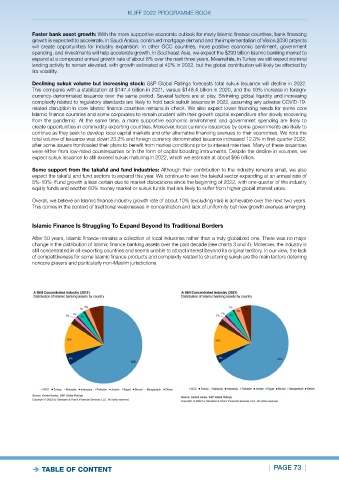
After 50 years, Islamic finance remains a collection of local industries rather than a truly globalized one. There was no major
change in the distribution of Islamic finance banking assets over the past decade (see charts 3 and 4). Moreover, the industry is
still concentrated in oil-exporting countries and seems unable to attract interest beyond its original territory. In our view, the lack
of competitiveness for some Islamic finance products and complexity related to structuring sukuk are the main factors deterring
noncore players and particularly non-Muslim jurisdictions.
TABLE OF CONTENT | PAGE 73 |

