


Page 75 - KLIFF2022eBook
P. 75
KLIFF 2022 PROGRAMME BOOK
One recent example is the implementation of Standard 59 of the Accounting And Auditing Organization for Islamic Financial
Institutions (AAOIFI). The market for hybrid sukuk that combine a commodity murabaha with tangible assets almost froze in
early 2021 when the standard came into force in the United Arab Emirates. The challenge issuers faced was how to implement
AAOIFI standards without changing the credit characteristics of the transaction. Lawyers eventually came up with a solution
that was acceptable to different stakeholders. However, this increased investor exposure to residual asset risks. As a result,
some investors decided to focus on more traditional markets, leaving sukuk for now.
One recent example is the implementation of Standard 59 of the Accounting And Auditing Organization for Islamic Financial
Institutions (AAOIFI). The market for hybrid sukuk that combine a commodity murabaha with tangible assets almost froze in
early 2021 when the standard came into force in the United Arab Emirates. The challenge issuers faced was how to implement
AAOIFI standards without changing the credit characteristics of the transaction. Lawyers eventually came up with a solution
that was acceptable to different stakeholders. However, this increased investor exposure to residual asset risks. As a result,
some investors decided to focus on more traditional markets, leaving sukuk for now.
In our view, the opposing forces of Sharia scholars advocating more equity-like characteristics and investors preferring
more debt-like characteristics could disrupt the market. This could materialize if and when scholars question the valuation
mechanisms for underlying assets, the setting of a purchase price at the time of issuance, or the payment of rent that is
uncorrelated with the value of the underlying assets. In our view, if sukuk become equity-like instruments, investor and issuer
appetite will likely diminish significantly. Therefore, standardizing and satisfying the requirements of all stakeholders is a plausible
way for the industry to remain attractive. We believe there are sukuk structures for the full spectrum of instruments, from fixed
income to equity like.
The Sustainability Angle Is Attracting Attention
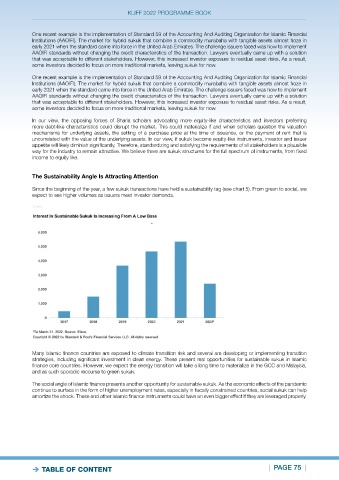
Since the beginning of the year, a few sukuk transactions have held a sustainability tag (see chart 5). From green to social, we
expect to see higher volumes as issuers meet investor demands.
Many Islamic finance countries are exposed to climate transition risk and several are developing or implementing transition
strategies, including significant investment in clean energy. These present real opportunities for sustainable sukuk in Islamic
finance core countries. However, we expect the energy transition will take a long time to materialize in the GCC and Malaysia,
and as such sporadic recourse to green sukuk.
The social angle of Islamic finance presents another opportunity for sustainable sukuk. As the economic effects of the pandemic
continue to surface in the form of higher unemployment rates, especially in fiscally constrained countries, social sukuk can help
amortize the shock. These and other Islamic finance instruments could have an even bigger effect if they are leveraged properly.
TABLE OF CONTENT | PAGE 75 |

